Why Does the Universe Obey Mathematics?
Why Does the Universe Obey Mathematics?
Have you ever found yourself, late at night, looking up at the stars and feeling a question form in the back of your mind? It’s not a question about any particular star or planet. It’s a deeper, more profound whisper from the cosmos itself. It’s a question that has haunted the greatest minds for millennia, and yet, it remains as mysterious as the dark matter weaving the galaxies together.
Why… does this… work?
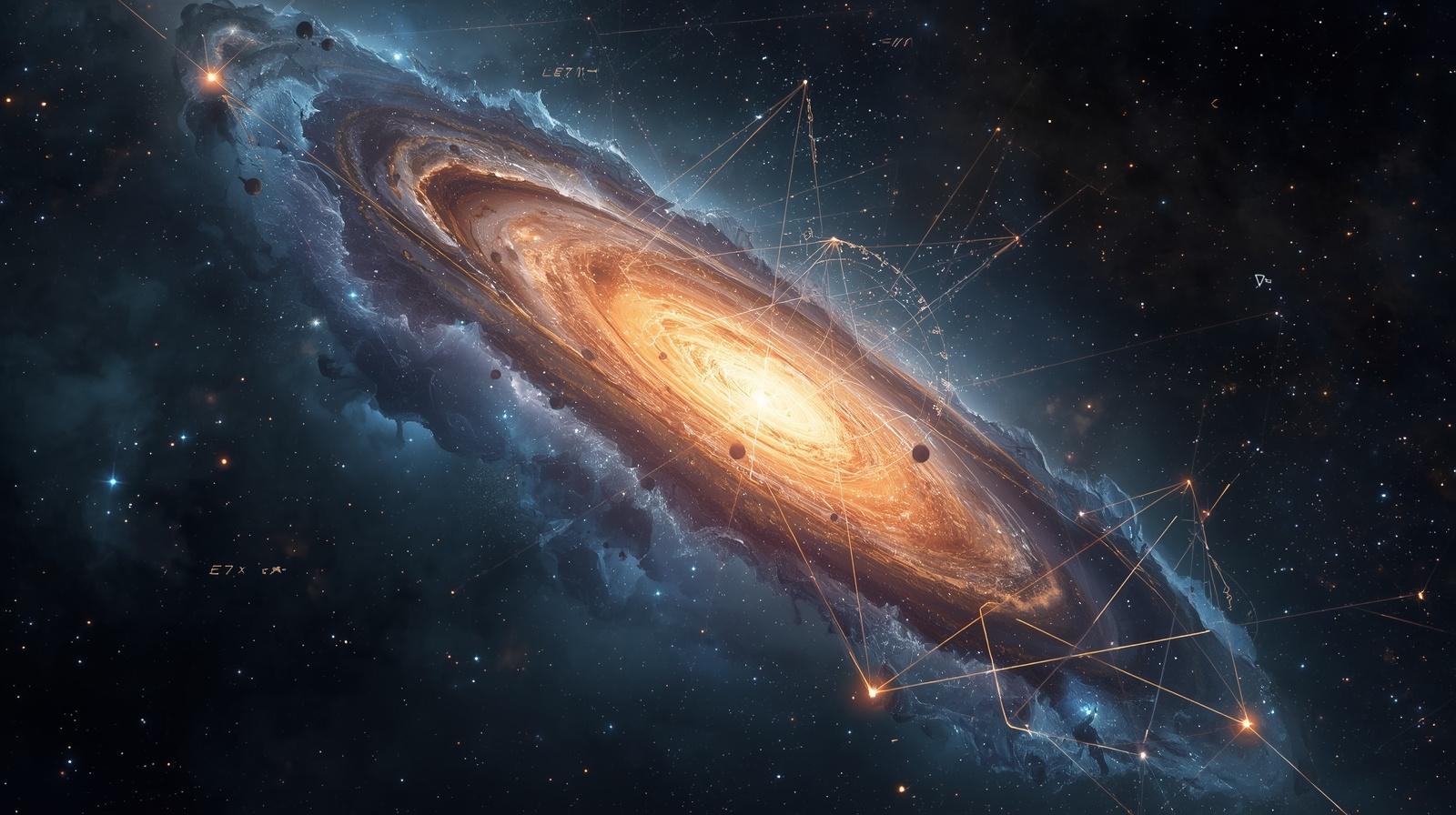
Look at a spiral. It’s the form of a shell of a creature that lived and died in an ancient ocean — a perfect logarithmic spiral. The same spiral we see in a distant galaxy, spinning in the void. The same spiral in the whirlpool of water draining from your sink. From the infinitesimally small to the cosmically vast, the same pattern repeats. It’s not a coincidence. It’s a code.
And the language of that code… is mathematics.
But why? Why is the universe speaking in numbers, in equations, in geometries? Is mathematics a human invention — a tool we cleverly crafted to describe the world? Or did we merely stumble upon the native tongue of reality itself? This isn’t just a scientific question. It is the greatest mystical riddle of all.
Watch: Why Does the Universe Obey Mathematics?
Before we dive deeper into the written exploration, you can watch the full video on this profound topic on YouTube. Hit play and let the mystery of mathematics and the cosmos unfold before your eyes:
▶ Watch on YouTube: Why Does the Universe Obey Mathematics?
Now, let’s journey together through the question that changes everything.
The First Crack in the Dam: Counting the Cosmos
Let’s travel back in time. Imagine the first human who counted. One, two, three. They weren’t inventing numbers. They were discovering a rhythm that was already there — the rhythm of their own hands, the rhythm of the seasons, the rhythm of the moon pulling the tides.
This was the first crack in the dam. The first hint that the chaos of existence had a hidden, silent order beneath it.
The ancient mystics and philosophers knew this intuitively. Pythagoras didn’t just have a theorem; he led a philosophical movement that believed the universe was literally made of number. They thought that the relationships between numbers — their harmonies and dissonances — were the secret music that built the cosmos. They called it the Music of the Spheres: a silent, celestial symphony that only the soul could hear.
They weren’t entirely wrong.
Consider this: long before we had telescopes capable of measuring distant galaxies, mathematicians working purely in the abstract realm of numbers discovered geometries and equations that would later prove to be exact descriptions of spacetime, black holes, and the curvature of the universe. Nobody told them to look for those things. They were simply following the inner logic of mathematics — and the universe confirmed their findings centuries later.
That is not coincidence. That is a conversation.
Gravity, Newton, and the First Mathematical Prophecy
Think of gravity. You don’t see it. You can’t touch it. But you feel its unwavering pull every second of your life. For most of human history, it was a mystery — a force ascribed to gods or simply taken for granted as an inherent property of things.
Then, a man observes a falling apple and the orbiting moon, and he dares to suggest that the same invisible hand is guiding them both. He doesn’t just describe it in words. He writes it in the language of mathematics. And suddenly, we could predict the motion of planets centuries into the future. We could plan the trajectory of a spacecraft, sling it around Jupiter, and have it arrive at a distant moon right on schedule.
That’s not just prediction. That’s participation in a conversation with the universe. And the universe is answering in perfect, flawless numerical sentences.
This pattern has repeated itself again and again throughout the history of science. Einstein wrote equations describing the warping of spacetime — purely theoretical at the time — and a century later, astronomers detected gravitational waves rippling through space exactly as those equations predicted. James Clerk Maxwell unified electricity and magnetism with elegant equations and discovered, embedded within them, the speed of light — a cosmic constant nobody had placed there intentionally.
The universe keeps confirming the mathematics before anyone even asks it to.
The Quantum Realm: Where Mathematics Becomes Magic
Now let’s push this into the realm of the truly astonishing.
Consider the atom. A tiny architecture of energy, mostly empty space. We have never “seen” an electron in the way we see a cup or a table. We can’t. Yet, using the language of mathematics, we can describe its behavior with such breathtaking precision that we can build entire civilizations of technology that run on that knowledge.
The device you are reading this on right now — whether a phone, a tablet, or a laptop — is a monument to the fact that the universe is mathematical at its core. We spoke the language of quantum mechanics, and the universe handed us the transistor. We recited an equation, and reality responded with microchips, the internet, artificial intelligence, and the entire digital world.
It’s as if we learned the correct incantation, and the cosmos opened a door that had always been there, waiting for us to find it.
But quantum mechanics goes even deeper into the strangeness. Particles behave according to probability waves — described by the Schrödinger equation — until they are observed. The act of measurement collapses a mathematical possibility into a physical reality. At the foundation of existence, there seems to be something profoundly mathematical and deeply intertwined with the act of knowing. The universe’s basement appears to be built from equations, not from solid stuff.
This is where the mystery deepens into something that can only be described as cosmic magic.
Two Breathtaking Possibilities
When confronted with the unreasonable effectiveness of mathematics — a phrase used by Nobel Prize-winning physicist Eugene Wigner — we face two staggering possibilities. Both are mind-bending. Both point toward something extraordinary about the nature of existence.
Possibility One: The Universe Is Mathematics
What if the cosmos is not merely described by mathematics, but it literally is mathematics?
This is a concept that some of the most forward-thinking physicists and mathematicians are seriously exploring. Physicist Max Tegmark, for example, has proposed what he calls the Mathematical Universe Hypothesis — the idea that our physical reality is not just described by mathematics but is, at its most fundamental level, a mathematical structure.
In this view, think of reality as a vast, cosmic computation unfolding on a substrate we do not yet fully understand. The laws of physics are its operating code. A star is a process in that computation. A thought in your mind is an extraordinarily complex algorithm running on the biological hardware of your brain.
In this framework, you, me, that distant galaxy — we are all like characters in an unimaginably sophisticated simulation, and the rules of that simulation are mathematical logic. We are not discovering the universe’s secrets. We are reading the source code of the reality we inhabit.
This is not necessarily saying we are in a simulation created by beings in a “higher” universe — though that remains a fascinating possibility worth exploring. Rather, it suggests that the fundamental nature of existence is computational, is mathematical. Reality is a beautiful, dynamic, evolving equation solving itself in real time, and we are its most self-aware variables.
Possibility Two: Mathematics Is the Mind of the Cosmos
The second possibility is, to many, the more mystical — and perhaps the more beautiful.
What if mathematics is not a human invention, but a form of discovery? What if the mathematical truths — the relationship of a circle’s circumference to its diameter, the nature of prime numbers, the structure of geometric forms — are eternal, timeless truths that exist in what Plato called the realm of perfect ideas?
In this view, mathematical reality is more fundamental than physical reality. The physical universe emerged from or within a pre-existing mathematical structure. Numbers and equations are not things we invented; they are things we found — like Columbus discovering a continent that had been there all along, patiently waiting to be mapped.
And here is where it becomes deeply personal.
What if our consciousness, our capacity to think and reason and feel wonder, is not merely a product of the universe’s blind physical processes, but a fragment of a greater cosmic intelligence? What if the mind is the universe’s way of knowing itself?
When a physicist has a breakthrough moment, when a mathematician suddenly sees the elegant solution to a problem that has resisted solution for centuries, what is actually happening? Perhaps they are not creating something new. Perhaps they are tuning their consciousness to the fundamental frequency of reality — briefly touching the deep mathematical structure that underlies all of existence.
In this view, the reason the universe obeys mathematics is because mathematics is the thought-process of whatever foundational intelligence — the Source, the Great Architect, the cosmic mind — that dreamed reality into being. And when we do mathematics, we are, for brief and brilliant moments, thinking those same thoughts.
The Unreasonable Effectiveness of Mathematics
In 1960, physicist Eugene Wigner published a now-famous essay titled “The Unreasonable Effectiveness of Mathematics in the Natural Sciences.” His central observation was that mathematics — a purely abstract human activity, a game of symbols invented in the mind — somehow manages to describe the behavior of the physical world with uncanny, even disturbing precision.
Wigner considered this remarkable fact to be a profound mystery that neither science nor philosophy had fully explained. Decades later, it remains unexplained.
Think about it this way: a mathematician sitting alone in a room, thinking about the abstract properties of curved spaces — with no intention of describing the physical universe — develops a geometry. Later, Einstein picks up that geometry and uses it to describe the fabric of spacetime itself. Nobody coordinated this. The mathematician was not thinking about physics. Yet the map fit the territory perfectly.
How? Why?
There are only two coherent answers: either the universe happens to be structured in a way that matches the patterns a human mind naturally generates when thinking abstractly (which seems like an extraordinary coincidence), or there is a deep and fundamental connection between the structure of the human mind, the structure of mathematics, and the structure of physical reality.
That connection — whatever it is — is one of the most important and least explored frontiers in all of human knowledge.
The Fibonacci Sequence: Nature Writing in Numbers
Nowhere is the mathematical nature of reality more visibly beautiful than in the Fibonacci sequence and the golden ratio derived from it.
Begin with 0 and 1. Add them to get 1. Add the last two numbers to get 2, then 3, then 5, then 8, 13, 21, 34… and so on forever. This simple recursive rule — add the last two numbers to get the next — generates a sequence that appears, spontaneously and independently, throughout the entire natural world.
The spiral of a nautilus shell follows it. The arrangement of seeds in a sunflower follows it. The branching pattern of trees and rivers follows it. The structure of DNA, when viewed from one end, reveals a Fibonacci spiral. The distances between planets in our solar system approximate golden-ratio relationships. Even the proportions of the human body, the length of limb bones relative to one another, reflect these numbers.
This pattern was not put there by human beings. We discovered it by observing nature and then recognizing it in our own mathematical constructions. Nature was writing in a language, and we learned to read it.
The golden ratio — approximately 1.618 — appears in the geometry of pentagons, in the spirals of galaxies, in the proportions that humans across cultures consistently judge as beautiful in architecture and art. It bridges the mathematical and the aesthetic. It suggests that beauty itself may be a perception of deep mathematical harmony — that when something strikes us as beautiful, we may be recognizing, at some level below conscious thought, that it conforms to the fundamental patterns of reality.
You Are the Universe Knowing Itself
Now, let’s talk about you. Because this isn’t just an abstract philosophical puzzle. This mystery lives in you, right now, in this very moment.
Your heart beats in a rhythm that can be analyzed with mathematics. The neurons in your brain fire in patterns that can be mapped with graph theory and information theory. The electrical signals that allow you to read these words — to comprehend meaning from symbols on a screen — propagate according to equations first written down by scientists studying the behavior of neurons as physical systems.
The love you feel for someone you care about — the warmth, the urgency, the vulnerability — is a product of neurochemical processes that operate according to physical laws, which are themselves mathematical in nature. The beauty you perceive in a sunset is your brain processing wavelengths of light, making comparisons across a vast database of past experiences, and generating an emotional response — all of it computable, in principle, if not yet in practice.
And the awe you feel when you grasp a profound idea — like the one we are exploring right now — that awe is the universe becoming aware of its own mathematical structure through the temporary vessel of your consciousness.
You are not a stranger in an indifferent cosmos. You are that cosmos, folded back on itself, capable of wonder. You are a walking, thinking, feeling manifestation of the universe’s deepest code. Every time you recognize a pattern, solve a problem, or feel the resonance of a mathematical truth, you are participating in something ancient and cosmic.
You are the universe’s way of learning its own language.
The Deepest Answer: Mathematics as Cosmic Language
So, why does the universe obey mathematics?
Perhaps it’s because the universe is mathematics — a grand, self-referential computation unfolding in the void, with no outside and no inside, just pure mathematical structure experiencing itself from within.
Or perhaps it’s because mathematics is the native language of the cosmic consciousness that dreamed all of this into being — and we, with our minds capable of mathematical reasoning, are that consciousness slowly waking up to its own nature.
Whichever answer resonates more deeply with you, the implication is the same: we are not strangers in a chaotic world. We are native speakers of the universe’s deepest secret. We are embedded in a reality of sublime, structured, breathtaking order. Every time you balance an equation, notice the symmetry of a snowflake, marvel at the regularity of the seasons, or simply count the beats of a drum — you are participating in this ancient, eternal, and glorious conversation between mind and cosmos.
The universe is not silent. It has been singing a mathematical song for 13.8 billion years. Every particle, every force, every field, every galaxy — all of it is a note in a composition of unimaginable beauty and complexity. And we — small, brief, improbable beings on a pale blue dot — are just beginning to hear the melody.
We are just beginning to understand that we are the melody, too.
Explore Further
If this exploration of the mathematical nature of reality has sparked something in you — a sense of wonder, a desire to go deeper — there are many ways to continue this journey together.
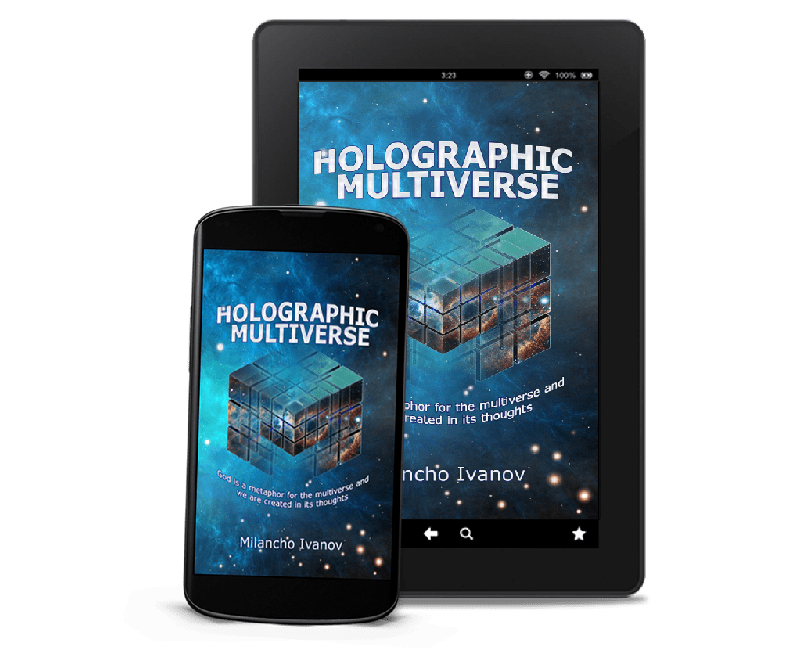
📖 Dive Deeper with the Book: Holographic Multiverse
Available as Audiobook, PDF, EPUB, and MOBI. The book takes you even further down this rabbit hole — exploring the idea that our reality may be a holographic projection, and what that means for consciousness, free will, and the very fabric of space and time.
👉 Get the Book Here
🌟 Join the Community on Patreon
Unlock exclusive content, download the book and bonus materials, and become part of a growing community of curious minds exploring the deepest questions about reality.
👉 Join Patreon Here
🌎 Visit the Website
Find more articles, videos, and explorations into the nature of reality at:
holographic-multiverse.com
📍 Stay Connected on Social Media

Related Posts
Recent Posts
Categories
*Available in EPUB, MOBI, PDF, MP3 (Audiobook)