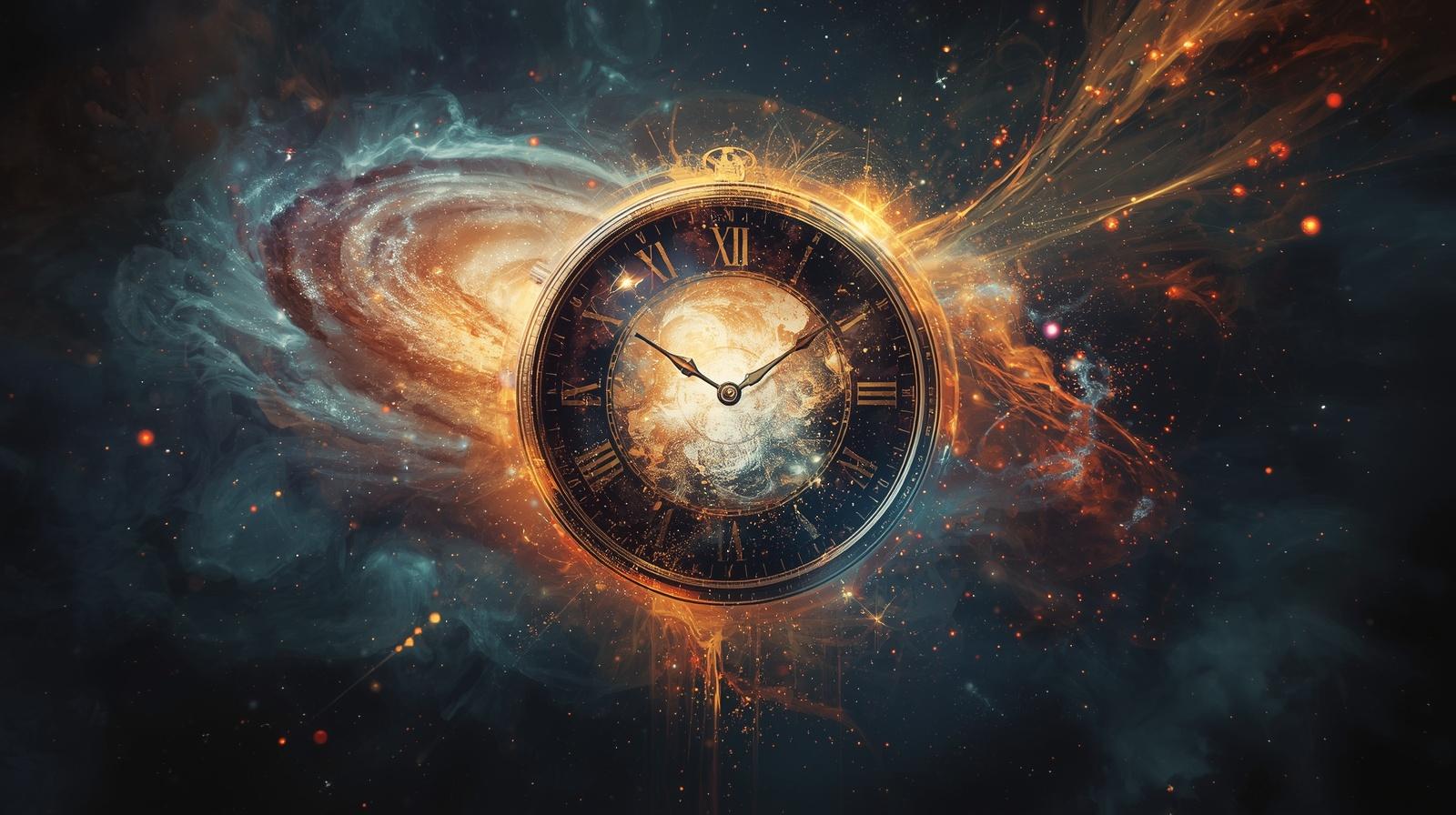
What Is Time?
What Is Time?
Look at your hands. For a moment, just look. See the lines on your skin, the subtle shift of light as your fingers move. In this very second, as you watch, trillions of cells in your body are dying and being reborn. The light from your screen has traveled a vast distance to reach your eyes, a journey that itself took… time.
We are all embedded within it. We measure it, we chase it, we waste it, we mourn its relentless passage. We say it flies, it heals, it is money. We speak of saving it and killing it, of losing it and spending it. But what is it, really? Strip away the metaphors and the clocks and the calendars, and what remains?
This is not just a question for physicists in lab coats or philosophers in ivory towers. This is the single most intimate and mysterious force shaping every moment of our existence. From the first beat of our hearts to the final whisper of a last thought, we are creatures of time. We are made of it. We swim in it like fish in water, so thoroughly immersed that we can barely perceive it at all. And yet, if you try to grab hold of it, to pin down what it actually is, it slips through your fingers like starlight.
So let us embark on a journey. Let us set aside our clocks and our calendars, our deadlines and our schedules, and dive deep into the great, shimmering, multi-layered mystery of time itself. We will move through physics and neuroscience, through ancient philosophy and speculative futures, through the intimate and the cosmic. By the end, we will not have solved the mystery. But we may have learned to hold it more beautifully.
The River of Time: Our Most Ancient Intuition
For most of human history, across every culture and civilization that has left us a record, time has been imagined as a river. A relentless, one-way flow from the source — the past — through the narrow, fleeting canyon of the present, and out into the vast, unknown ocean of the future. The past is fixed, solid, immovable, a mountain range of settled memories and completed events. The future is fluid, unwritten, a shimmering realm of infinite possibilities not yet collapsed into fact. And the present is the razor-thin edge where the two meet, the only place where anything can actually happen.
This feels profoundly and obviously true. It is so deeply embedded in our experience that it feels less like a theory about time and more like a direct perception of it. It is woven into every language, every story, every human institution. We plan for the future because it has not happened yet. We grieve the past because it cannot be changed. We act in the present because it is the only moment in which action is possible.
Physicists have given this intuition a name: the Arrow of Time. The arrow always points forward. We remember yesterday, but we cannot remember tomorrow. A cup can fall from a table and shatter on the floor, but the fragments will never spontaneously leap back together and reassemble themselves into an unbroken cup. Heat flows from hot objects to cold ones, never spontaneously in reverse. These asymmetries between past and future seem like fundamental, inviolable features of reality.
But here is the mystery that has haunted physics for over a century: why does the arrow only fly one way?
When physicists write down the fundamental equations of nature — the laws that govern how particles interact, how fields propagate, how gravity curves space — those equations are almost entirely symmetrical in time. They work just as well running backwards as forwards. If you filmed two subatomic particles colliding and then ran the film in reverse, there would be nothing in the physics to tell you it was backwards. The laws of nature, at their deepest level, appear to be indifferent to the direction of time.
So where does the arrow come from? The answer that modern physics gives is subtle and profound. It does not come from the laws themselves. It comes from the initial conditions of the universe. Think of a brand-new deck of playing cards, fresh from the factory, arranged in perfect numerical and suit order. That pristine arrangement is an extraordinarily special, extraordinarily unlikely state among all the possible ways the cards could be arranged. Shuffle the deck once, and it becomes disordered. Keep shuffling, and it will almost never return to that original perfect order, not because there is any law against it, but simply because there are vastly more disordered arrangements than ordered ones. Disorder is statistically overwhelmingly more probable than order.
The universe, in the moments following the Big Bang, was in an astonishingly ordered, low-entropy state — like that perfect, untouched deck. Ever since, it has been shuffling itself, following the statistical gradient from improbable order toward probable disorder. This tendency is captured in the Second Law of Thermodynamics, which states that the total entropy — the total disorder — of a closed system tends to increase over time.
In this picture, the Arrow of Time is simply the universe’s ongoing journey from its extraordinarily special initial state toward ever-greater disorder and equilibrium. Our deep, visceral sense of past and future is the subjective experience of riding this thermodynamic wave, moving always from lower entropy to higher entropy, from the crystalline improbability of the early universe toward the warm, uniform equilibrium of its far future.
It is a beautiful and powerful answer. But it explains only the direction of time, not its feel. It does not explain why we experience ourselves as moving through time, why the present moment feels so vivid and real, why the past feels like memory and the future feels like anticipation. For that, we need to go deeper.
Einstein’s Revolution: The Frozen Block Universe
Now let us shift our perspective entirely. What if the flowing river is itself an illusion? What if the past, the present, and the future do not succeed one another at all, but instead all exist simultaneously, laid out like a vast, static landscape that simply is, rather than something that perpetually becomes?
This is not a fanciful speculation. It is a direct and carefully reasoned implication of Albert Einstein’s theory of relativity — one of the most precisely tested and thoroughly confirmed scientific theories in human history. Einstein’s great insight was that space and time are not separate, independent entities. They are aspects of a single, unified, four-dimensional structure that physicists call spacetime.
In classical physics, before Einstein, time was universal. A clock in Paris and a clock in Tokyo, if synchronized, would always agree on what time it was, and every event in the universe would have a single, objective “when.” Einstein shattered this picture. He showed that the rate at which time passes depends on how fast you are moving and how strong the gravitational field around you is. Clocks in motion run slow. Clocks in strong gravitational fields run slow. Two observers moving relative to each other will disagree not just about when events occur, but about whether two spatially separated events are simultaneous at all.
The revolutionary implication is this: there is no universal “now.” The present moment is not a global feature of reality. It is a local, observer-dependent construction. And if there is no universal present, then there is no universal dividing line between past and future. The entire distinction between past, present, and future — so fundamental to our ordinary experience — turns out to be relative, dependent on the state of motion and position of the observer.
In the mathematical framework that Einstein’s relativity requires, every event in the history of the universe has its own fixed coordinates in four-dimensional spacetime — its “where” and its “when.” From a theoretical perspective outside this structure — the perspective of the equations, rather than any particular observer embedded within the universe — all of these events simply exist simultaneously, as co-present features of a static four-dimensional geometry. Your birth, the fall of Rome, the death of a distant star five billion years ago, the formation of galaxies yet to come — all are equally real, equally present, as fixed features of the cosmic tapestry.
This view of reality is called the Block Universe. In the Block Universe, time is not something that flows or passes. The universe does not evolve or change. It simply is, all at once, a complete and unchanging four-dimensional object. Past, present, and future are equally real and equally existent. What we call “now” is just the particular slice of the block that a given observer happens to be located on, defined by their position and motion in spacetime. The feeling that time flows, that there is a moving present moment, is an artifact of consciousness — the subjective experience of a being who exists within the block and can only access it one slice at a time.
Think of a film stored on a digital disc. The complete movie is there in its entirety — every scene, every line, the opening and the ending, all simultaneously encoded on the disc. The narrative “flows” only when a laser reads the disc frame by frame. Take away the laser, and there is no flow, only the complete, static whole. In the Block Universe, your consciousness is the laser. The spacetime block is the disc. The movie of your life is already complete. You are simply reading it.
This picture is philosophically vertiginous. It implies that every moment of your life — not just the present one, but all of them, from your earliest memories to your final breath — exists permanently and eternally in the structure of spacetime. Nothing is ever truly lost. Nothing ever truly ends. Every laugh, every loss, every ordinary Tuesday afternoon is a permanent, indestructible feature of the cosmos, fixed forever in the block.
Yet here the paradox deepens. Physics gives us two frameworks, each internally consistent, each supported by experiment, and each pointing to something profoundly different about the nature of time. Thermodynamics says time has a direction, a real asymmetry between past and future, rooted in the universe’s journey from low entropy to high. Relativity says there is no universal present, no objective flow, only the static block in which all moments coexist. Both cannot be the complete and final truth. Perhaps each is a different shadow of a deeper reality that neither fully captures.
The Mind as Time-Maker: How Your Brain Constructs the Present
If physics leaves us with a paradox, perhaps the most revealing answers lie closer to home — not in the equations that describe the large-scale structure of the universe, but in the extraordinary, still poorly understood process by which a human brain generates the experience of being present in time.
Your brain is not a passive recorder of time. It does not simply log the passing seconds like a faithful clock. It is an extraordinarily active, extraordinarily creative constructor of temporal experience. Every moment you are awake, your brain is engaged in the task of taking a vast, chaotic, continuous flood of sensory signals — light, sound, touch, temperature, proprioception, the rhythms of your own heartbeat and breathing — and weaving them into something coherent: a unified, continuous narrative of experience, with a clear sense of sequence, of before and after, of a flowing present embedded in a remembered past and an anticipated future.
This construction process is astonishingly complex, and it is deeply susceptible to distortion, modulation, and outright failure. Consider how time feels during genuine danger. In the seconds of a near-miss accident, time can seem to slow dramatically, every detail sharpening into crystalline clarity, the sequence of events unfolding with a strange, agonizing vividness. Neuroscientists believe this is not because time actually slows, but because the brain, flooded with stress hormones and operating at heightened alertness, samples its environment at a much higher rate — recording more distinct moments per second of clock time, and thus producing a memory that feels richer and slower than ordinary experience.
Now consider the opposite: a perfect afternoon in the company of people you love deeply, a state of creative flow so complete that you lose all awareness of the clock. Hours collapse to what feels like minutes. The richness of the experience compresses time rather than expanding it, because absorption and joy suppress the mechanisms of temporal monitoring. Or think of the strange, suspended quality of profound grief, in which days can feel simultaneously endless and instantaneous, the ordinary structure of time dissolving in the altered state that loss creates.
These are not quirks or failures of the time-perception system. They reveal something important: there is no single, dedicated clock in the brain. Neuroscientists have searched for it and not found it. Instead, time perception appears to be a distributed, emergent phenomenon, arising from the coordinated activity of multiple brain systems — memory consolidation, attentional networks, emotional processing, predictive modeling. The brain constructs its sense of time moment by moment, drawing on all of these systems simultaneously, calibrating and recalibrating continuously.
In a profound sense, the time you experience is not something that exists independently in the physical world and is then accurately perceived by your brain. It is something your brain actively generates, using the raw material of physics and biology to create the specific, personalized, emotionally colored temporal landscape of your conscious life. Your “now” is not a window onto an objective present. It is a construction, an interpretation, a story your brain tells about the order and duration of events.
This does not make your experience of time less real. It makes it more interesting. It means that the deepest questions about time are not just questions for physicists, but questions for neuroscientists, psychologists, and phenomenologists — and ultimately, for each of us, as experiencers of the extraordinary gift and mystery of conscious awareness.
Time as Maya: The Ancient Wisdom of the Eternal Now
Long before Einstein formulated his equations, long before thermodynamics had a name, the great wisdom traditions of the ancient world were already grappling with the nature of time — and arriving at conclusions that are, in their own way, as radical as anything modern physics has produced.
The Sanskrit philosophical traditions of ancient India, particularly those of Advaita Vedanta and certain schools of Buddhist thought, speak of time as Maya — the great illusion, the cosmic veil, the creative power through which the infinite and the eternal appears to itself as finite, temporal, and subject to change. Maya is not “false” in the crude sense of being simply wrong or non-existent. It is more subtle than that. It is a way of perceiving that is real at its own level but which, from a deeper standpoint, obscures a more fundamental truth.
The more fundamental truth, in these traditions, is this: the ultimate nature of reality is a single, undivided, infinite, and eternal consciousness. Not the individual consciousness of a particular mind or person, but consciousness itself, prior to all differentiation, the ground of all being. This ultimate reality is described as inherently timeless — not simply very long-lasting or ancient, but genuinely without temporal location or duration, beyond the categories of before and after altogether.
In this understanding, the universe and everything in it — including you, including your experience of reading these words right now — is a kind of dream or play of this ultimate consciousness. The many appear within the One. The temporal appears within the Eternal. Separation appears within Unity. Not as a mistake or a fall, but as a deliberate, creative, self-exploratory movement of infinite awareness choosing to know itself through an infinite variety of finite perspectives and experiences.
You, in this picture, are not merely a small, temporary creature embedded in a large, impersonal universe, swept along by a river of time you did not choose and cannot control. At the deepest level of your being, you are that infinite awareness, temporarily and voluntarily inhabiting the perspective of a particular body, mind, and life story. You are, as the Vedantic teachers would say, not the wave but the ocean — not a drop of water being carried along, but the water itself, the river, the source, and the sea.
This is not just a poetic metaphor. It is a statement about what consciousness actually is at its most fundamental level, a statement that has been arrived at through rigorous introspective practice by some of the most carefully trained minds in human history. And it converges, in striking ways, with the Block Universe of Einstein and with the quantum-mechanical picture of a universe in which all possibilities exist simultaneously until the act of observation collapses them into a particular actuality.
From this perspective, the moments of our lives that seem to break through the ordinary structure of time — the deep stillness of genuine meditation, the timeless quality of profound love or grief, the strange recognition of déjà vu, the luminous vividness of a moment that seems to last forever even as it passes — are not anomalies or illusions. They are moments of thinning, instances in which the construction of sequential time temporarily loosens its grip and something deeper, something that was always already present beneath the surface, becomes briefly perceptible.
We are, perhaps, always already in eternity. We have simply agreed, collectively and individually, to tell ourselves the story of time.
The Fractal Multiverse: Time as an Infinitely Branching Tree
There is one more picture of time that we need to consider — one that emerges from the deepest and strangest layer of modern physics: quantum mechanics.
In the standard interpretation of quantum mechanics developed in the early twentieth century, physical systems do not have definite properties until they are measured or observed. A particle does not have a specific position or momentum until that property is measured; before measurement, it exists in a superposition of all possible values simultaneously. When a measurement is made, this superposition “collapses” into a single definite outcome, and the other possibilities vanish.
This picture has always been philosophically unsatisfying, because it requires a sharp distinction between the “quantum world” of superposed possibilities and the “classical world” of definite outcomes — a distinction that seems arbitrary and whose location is unclear. In 1957, the physicist Hugh Everett III proposed a radical alternative: what if the wavefunction never collapses? What if every possible outcome of every quantum measurement actually occurs, in a separate, equally real branch of reality?
This is the Many-Worlds Interpretation of quantum mechanics, and it has profound implications for the nature of time. In the Many-Worlds picture, the universe is not a single history but an inconceivably vast and perpetually branching tree of histories, all equally real, all developing according to the same physical laws. Every quantum event — and quantum events are occurring constantly, at every scale, in every object in the cosmos — causes the universe to branch into multiple versions, each containing a different outcome.
What does this mean for you? It means that at every moment, at every fork in the road of quantum possibility, reality splits. The version of you who chose to read these words and the version who clicked away and did something else both exist, in different branches of the quantum multiverse, each living out a complete and genuine life. The you who accepted a certain offer and the you who declined it, the you who said something kind at a crucial moment and the you who said something unkind — all of these versions of you are real, each pursuing their own timeline in their own branch of the endlessly proliferating cosmic tree.
Your experience of a single, linear timeline — a life that unfolds in one direction, making one set of choices, living one story — is the local perspective of one particular strand of consciousness woven through this vast and complex whole. You are not a single thread. You are, in some deep sense, the entire tapestry.
Time, in this picture, is not a line. It is not even a plane. It is a fractal — a structure of infinite complexity that looks the same at every scale, a perpetually branching, perpetually blossoming tree of actualized possibilities, rooted in the quantum state of the early universe and flowering outward without limit into an infinite proliferation of equally real histories. Every moment contains within it the seed of an unbounded multiplicity of futures. Every now is the root of an infinite tree.
Your consciousness — this particular, specific, irreplaceable pattern of awareness that you are — is what physicists might call a strange attractor in the phase space of all possible minds: the organizing principle that gives coherence and continuity to one particular, beautiful, unrepeatable path through the infinite garden of branching time.
So, What Is Time? A Synthesis
We have traveled a considerable distance together. What have we found?
Time is the shuffling of the cosmic deck — the universe’s one-way drift from the extraordinary low-entropy order of its beginning toward the maximum disorder of its far future, the thermodynamic gradient that gives the Arrow of Time its undeniable direction and makes the past irrecoverably different from the future.
Time is a dimension in a frozen block of reality — a fourth coordinate in the static, eternal geometry of spacetime described by Einstein’s relativity, in which all moments already exist with equal reality, and the felt sense of a moving present is a feature of the observer embedded within the block, not a feature of the block itself.
Time is a story woven by the mind — a subjective, personalized, continuously updated narrative generated by the brain from the raw material of sensory experience and memory, shaped and colored by emotion, attention, and the specific state of the nervous system in each moment, different for every person and different for the same person at different times.
Time is the great veil of Maya — the creative illusion described by the world’s oldest wisdom traditions, through which an infinite and eternal awareness temporarily experiences itself as finite, temporal, and embedded in sequence, not as a mistake or a limitation, but as the very medium of experience, learning, and growth.
And time is a fractal tree of infinite possibility — the ever-branching, ever-blossoming structure of quantum reality, in which every conceivable outcome of every quantum event is equally real, and your experience of a single linear life is the local perspective of one particular strand of consciousness navigating an unfathomably vast and complex whole.
Time is all of these things simultaneously. And it is, in the same breath, none of them entirely, because each description is a partial map, and the territory it points toward is far too vast, too deep, too alive, too full of surprise to be fully enclosed within any single human concept, equation, or metaphor.
Perhaps the most honest and most beautiful thing we can say is this: time is the universe’s way of ensuring that everything does not happen all at once. And it is also, from a different angle, the proof that in some profound and final sense, everything already has.
We are temporary. We are eternal. We are the dream and the dreamer both. We are the wave, and we are the ocean. And in that paradox — that impossible, luminous, inexhaustible paradox — lies the truest answer available to us right now, in this moment, to the deepest question we can ask: What is time?
Watch the Full Video on YouTube
If this exploration has sparked something in you — if it has made you look at the world around you with new wonder, or left you sitting quietly with the strangeness of your own existence for a moment — the full video essay on YouTube goes even deeper. The same journey, in a different form, with a different texture.
Dive Deeper: The Holographic Multiverse Book
For those who want to go even further — to trace the deep connections between quantum physics, consciousness, and the nature of reality in a sustained and comprehensive way — the book Holographic Multiverse was written precisely for that purpose. It connects the dots between the cutting edge of theoretical physics, the ancient wisdom traditions, and the deepest questions about the nature of mind and existence. Available as an Audiobook, PDF, EPUB, and MOBI.
📖 Get the Book Here: https://www.patreon.com/c/holographicmultiverse/shop
🌟 Unlock Exclusive Content on Patreon — Download the book along with bonus materials and become part of a growing community of minds exploring the deepest questions of existence together.
👉 Join Patreon: https://www.patreon.com/holographicmultiverse/membership
Stay Connected
The exploration of time, consciousness, and reality is not a destination — it is an ongoing, ever-deepening conversation. Stay connected and be part of that conversation across all platforms:
🌐 Website: https://www.holographic-multiverse.com
📹 YouTube: @holographicmultiverse — New video essays on physics, consciousness, and the deep structure of reality
📘 Facebook: @ivanovmilancho
📸 Instagram: @ivanovmilancho
🐦 X (Twitter): @ivanovmilancho
The future is not a place you are going. It is a reality you are creating — right now, in this very moment, with every thought and every choice. Stay curious. Stay open. Keep exploring.

Related Posts
Recent Posts
Categories
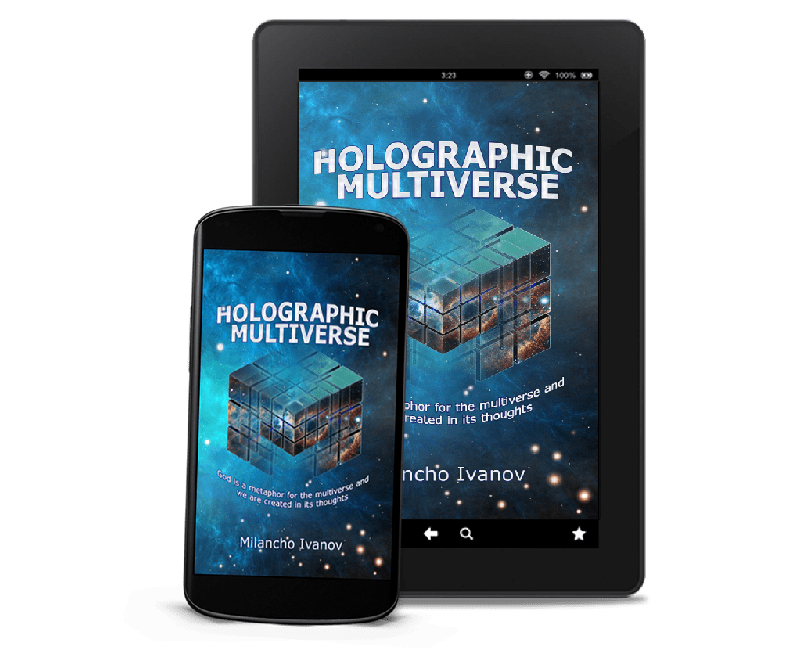
*Available in EPUB, MOBI, PDF, MP3 (Audiobook)